
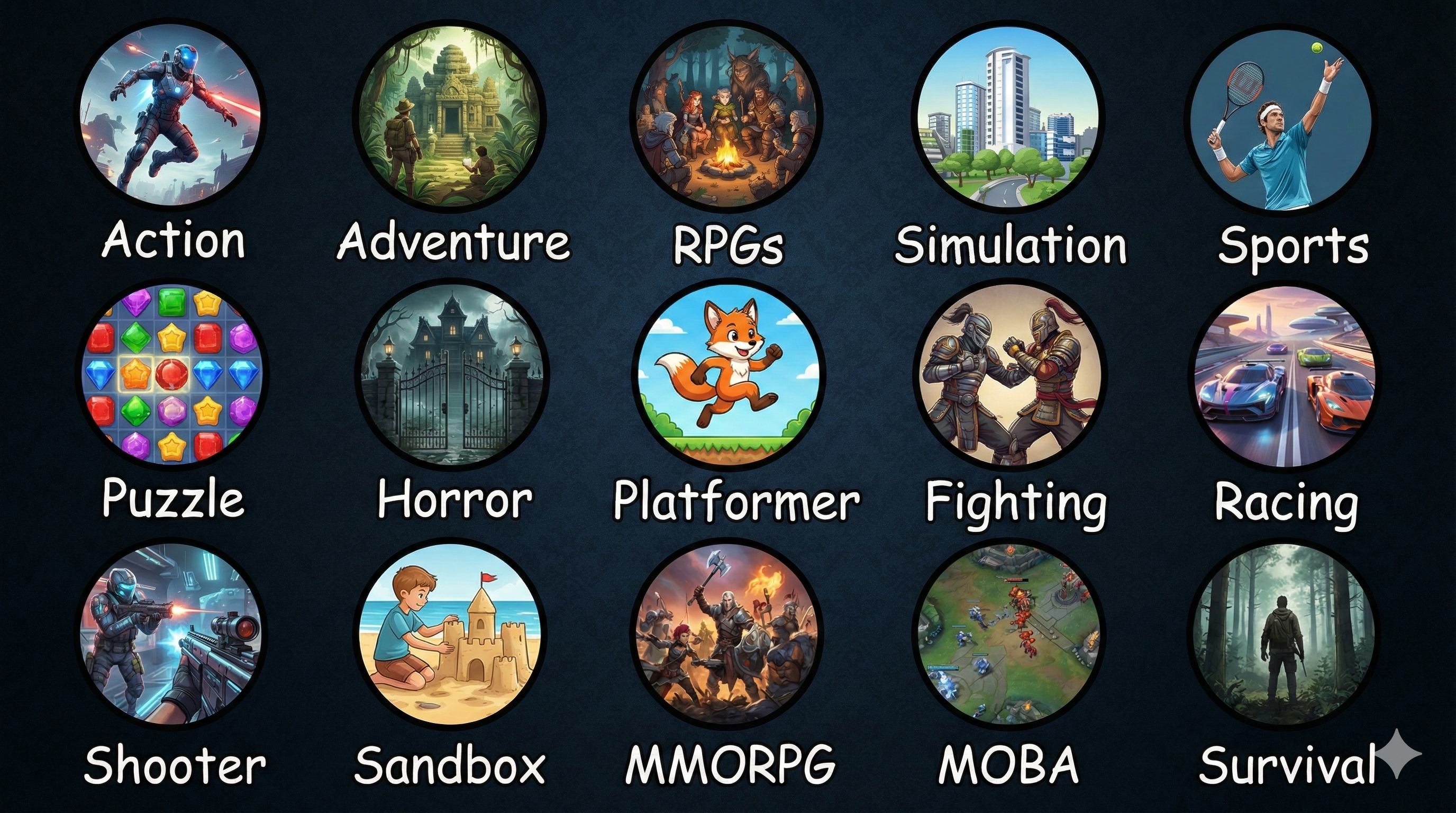
Most teams talk about pipelines as if they are a fixed recipe. In practice, pipelines bend around genre. A first-person shooter lives or dies on responsiveness and combat readability. An RPG survives on progression, content cadence, and narrative consistency. A simulation game is only as strong as the systems underneath it.
This is why gaming genres are not just marketing labels. They reshape how levels are built, how animation is authored, how QA is planned, and how content is scheduled across a milestone calendar. If you want clean production, you align tools and workflows to the genre’s core promise, then you protect that promise all the way to shipping.
We build support pipelines around those realities, whether the project is gameplay-heavy, narrative-led, or systems-driven. You can see how we frame production use cases across teams on our applications page.
Table of Contents
FPS pipelines: responsiveness, readability, and iteration speed
RPG and simulation pipelines: content scale versus system depth
Why Genre Changes The Pipeline?
Every pipeline is really a set of bets. You bet on what the player will notice, what they will forgive, and what they will do repeatedly.
In gaming genres, those bets are different:
Shooter players will repeat core actions thousands of times. Small animation latency and camera feel problems become big problems.
RPG players accept slower traversal and more UI if progression feels meaningful and choices stay consistent.
Simulation players tolerate simple visuals if systems feel believable, reactive, and stable over long sessions.
So pipeline differences are not cosmetic. They change what you prototype first, what you polish longest, and what you automate because the content volume will bury you otherwise.
FPS Pipelines: Responsiveness, Readability, And Iteration Speed
An FPS pipeline is built to protect one thing above all. Feel. That “feel” is the sum of input, camera, animation timing, VFX readability, and level flow under pressure.
What FPS teams prioritize early?
Input-to-action timing: Animation and code cannot fight each other. If a reload looks great but delays control, it gets cut or redesigned.
Combat readability: Silhouettes, hit reactions, muzzle flash behavior, and audio cues are functional. They are not decoration.
Encounter iteration: Level design needs fast greybox loops. If it takes a week to test a new encounter layout, the game ships with weaker combat.
Animation and camera realities in shooters
FPS animation is less about long performances and more about repeatable clarity.
Weapon sets: Locomotion, aim offsets, recoil, reloads, sprint transitions, and stance changes have to blend cleanly.
State machines: You spend real time on transition rules because players interrupt everything. Slide into reload. Cancel to melee. Swap weapons mid-jump.
First-person versus third-person parity: Many shooters need both. First-person hands must feel tight. Third-person full body must still read to opponents and spectators.
Motion capture still matters, but the target is not theatrical nuance. It is consistent timing and believable weight that survives heavy blending. A typical capture-to-engine path includes a capture session with clean take management, followed by cleanup, retargeting, curve polish, and strict naming conventions so gameplay hooks stay stable.
Level design for FPS flow
Shooter levels are tuned like competitive spaces even when the game is single-player.
Sightline control: You plan lanes, cover, and occlusion so players read threats fast.
Rhythm: Combat peaks, decompression pockets, and traversal beats are designed like a waveform.
Metrics discipline: Door widths, stair heights, mantle edges, and cover heights need consistency or movement feels unreliable.
Cinematics exist in shooters, but they rarely get to slow the game down for long. The pipeline has to support quick in-engine story beats that hand control back smoothly.
RPG And Simulation Pipelines: Content Scale Versus System Depth
RPG and simulation production often look similar from a distance. Both can be content-heavy. Both can be systemic. The difference is what drives the player’s long-term engagement.
RPG pipelines: progression plus authored meaning
RPG pipelines typically scale around breadth.
Quest structure: Quest scripting tools, dialogue systems, and branching logic need to be designer-friendly. Writers and designers ship together, not in sequence.
Progression economy: Stats, loot tables, crafting, and skill trees create a balancing workload that never ends. Your pipeline must support rapid tuning.
Narrative continuity: When players do content out of order, story state still needs to make sense. That means disciplined flagging and clear ownership of narrative variables.
Cinematics and performance matter a lot here, especially for companion scenes and major story beats. Facial capture becomes a high-value investment because players spend time close to characters. Camera blocking and edit timing have to respect player expectation and character identity.
On the content side, RPG pipelines often benefit from 3D scanning for believable props, costumes, and faces. The catch is optimization. Real-time performance budgets, LOD strategy, and material consistency matter more than raw detail, especially across large worlds.
Simulation pipelines: system truth over authored content
Simulation pipelines scale around depth and stability.
Core systems: AI behaviors, economy rules, physics, traffic, crowds, weather, or machine logic. The pipeline prioritizes correctness and predictability.
Data-driven authoring: Designers need spreadsheets, graphs, and debug views, not just art tools.
Long-session stability: Save systems, determinism, and edge-case handling become frontline production tasks.
Animation in simulation projects is often about coverage and context.
Library breadth: Many simple interactions that can be recombined across situations.
Procedural assist: IK, look-at, locomotion blending, and runtime adjustments so characters fit varied terrain and props.
Readable feedback: Players need to understand why the system did something, so reactions and VFX are part of UI.
Simulation games also lean heavily on technical art. Shaders for readability, tools for automation, and profiling workflows are core pipeline components, not late-stage polish.
Where RPG and simulation intersect?
Both genres benefit from systems, but they weaponize them differently.
RPG systems serve narrative and progression.
Simulation systems are the game.
That distinction changes where you spend mocap time, how you author levels, and how you schedule QA. In gaming genres like these, production success usually comes down to keeping authored content and systemic behavior from contradicting each other.
FPS vs RPG vs Simulation: Pipeline Priorities Side By Side
Pipeline area | FPS | RPG | Simulation
Core promise | Tight feel and combat clarity | Meaningful progression and character investment | Believable systems and long-session depth
Pre-production focus | Movement metrics, weapon sandbox, encounter loop | Quest framework, progression economy, world rules | Core system modeling, data architecture, debugging tools
Level design | Lanes, sightlines, combat rhythm | Spaces that support exploration, hubs, story gates | Spaces that support systemic behavior and readability
Animation | Fast transitions, aim offsets, combat loops | Performance plus gameplay loops, companion behaviors | Broad interaction library, procedural support
Cinematics | Short, functional, fast hand-offs | High-value story scenes, facial performance | Minimal or contextual, often system-driven
Tech art | Readability and performance under effects load | Consistency across large content sets | Tooling, automation, profiling, debug visualization
QA burden | Timing, exploits, map balance, netcode edge cases | Quest state bugs, progression breaks, content ordering | System edge cases, saves, determinism, long-run stability
Applications In Production
Different genres create different production pressure points. The best pipelines plan for those pressures instead of reacting to them.
Combat loops: Responsiveness tuning: Tight transitions, state machines, and animation blending that keep input feeling immediate.
Quest content: State safety: Clear narrative flags, rejoin points, and designer tooling that prevents broken quest chains.
System sandboxes: Debug visibility: In-editor visualizers and logging so designers can understand system decisions.
Character delivery: Performance continuity: Mocap capture, cleanup, retargeting, and facial capture support that holds up across gameplay and cinematics.
In-engine storytelling: Seamless hand-offs: Camera blocking and animation staging that returns control without pops or broken locomotion.
Gameplay animation: Loop reliability: Genre-appropriate libraries built for real-time gameplay animation, where repeatable transitions matter as much as hero moments.
Benefits
When pipelines match genre, teams waste less time fighting their own game.
Fewer rewrites: Systems and content are designed to agree early.
Faster iteration: Tools and blockouts support quick testing of the core loop.
Cleaner outsourcing handoffs: Deliverables map to real engine needs, not abstract asset lists.
Better performance outcomes: Budgets are built around the genre’s hotspots, like VFX-heavy firefights or long simulation runs.
More confident shipping: QA focuses on the genre’s real failure modes.
Considerations For Production Teams
Genre-aligned pipelines still fail if production discipline slips. These are the pitfalls that show up most often.
Milestone design: Vertical slice integrity: Build a slice that proves the genre promise, not just visual fidelity.
Content planning: Cadence math: Estimate content by implementation complexity, not by page count or asset count alone.
Tool adoption: Designer autonomy: If designers cannot author, test, and debug without engineering help, the pipeline will choke.
Animation scope: Library strategy: Decide what is mocap, what is keyframed, what is procedural, and what can be reused safely.
Cinematic discipline: Shot economy: Protect the moments that matter, and keep the rest in-engine and efficient.
Performance reality: Budget enforcement: Profile early, set targets, and treat LODs, materials, and lighting as part of content definition.
AI complexity: Behavior constraints: For smarter NPCs, define tone, memory rules, and failure handling so systems do not contradict story logic.
Future Outlook
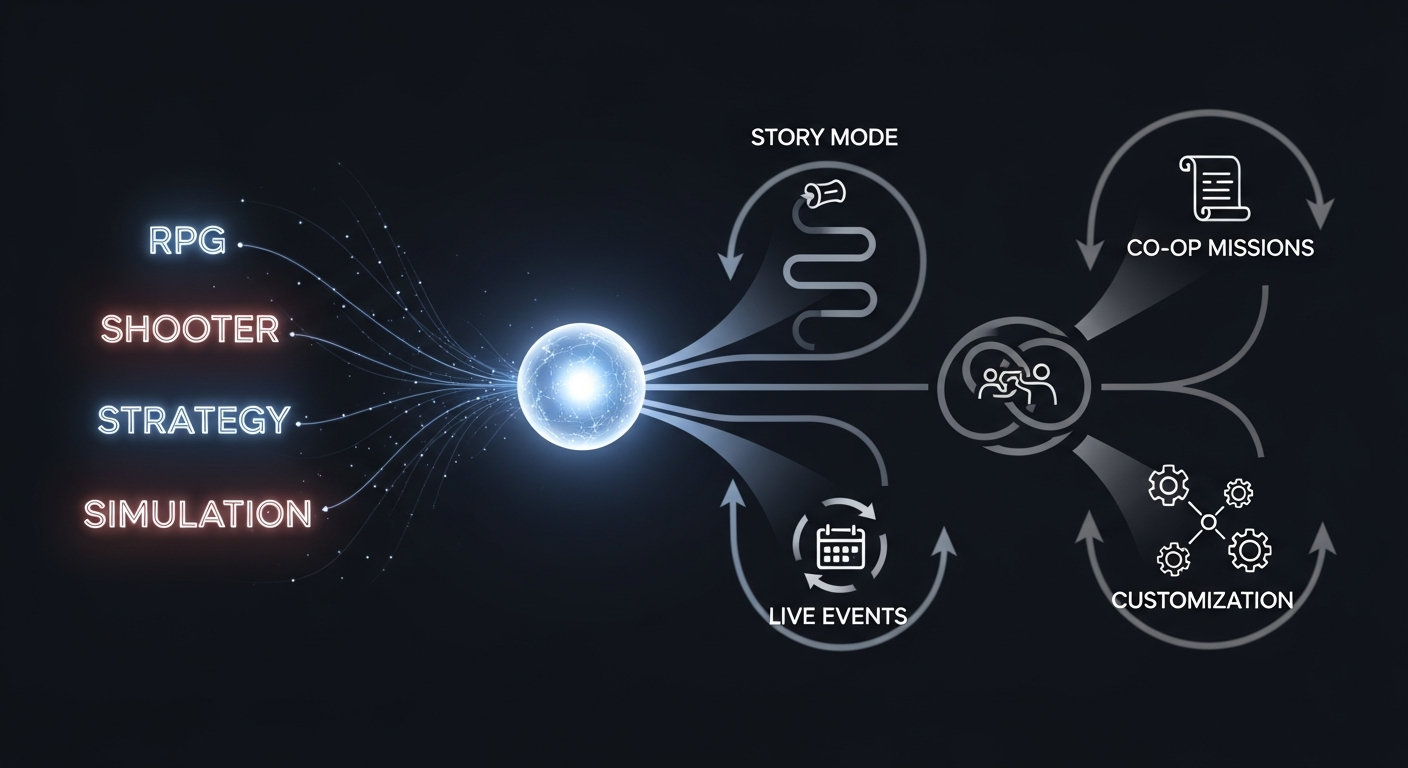
The next big shift across gaming genres is pipeline convergence inside real-time engines. Shooters are borrowing more narrative staging. RPGs are pushing more systemic reactivity. Simulation games are adopting richer character presentation as tools and hardware improve.
AI-driven NPC behavior will amplify this, but it raises a production question. How do you keep characters consistent when the system can generate or vary responses? The answer is not more dialogue. It is better constraints, better authoring interfaces, and more robust state handling. Done well, it gives RPGs more reactivity, gives shooters more believable squads, and gives simulations more human-scale drama.
XR is another pressure cooker. You cannot rely on traditional camera grammar. Interaction clarity and comfort become narrative tools. Performance budgets get tighter, and technical art has to carry more of the readability load through shaders, lighting discipline, and automation.
The teams that win here will treat genre as a production spec. Not a label. A spec that tells you what to prototype first, what to polish last, and what to automate so the game remains shippable.
Conclusion
Pipelines are not neutral. They express priorities. The reason FPS, RPG, and simulation games feel so different is that the production workflows behind them are different by necessity. The gaming genres you choose determine where you can cut corners, where you cannot, and what kind of tooling and animation support you need to stay stable across the build.
When a pipeline matches the genre promise, the game feels confident. Controls are clean. Systems are readable. Story moments land without breaking play. That is the standard we build toward at Mimic Gaming, with craft-first animation, practical engine integration, and production workflows designed to survive scale.
FAQs
What are gaming genres in production terms?
They are player promises that translate into production priorities. Genre determines which systems, content types, and iteration loops must be protected.
Why do FPS pipelines emphasize animation transitions so much?
Because players interrupt actions constantly. Fast, reliable transitions and state machines preserve responsiveness and prevent visual glitches.
What makes RPG pipelines harder to schedule than shooters?
RPGs often have higher content volume and more narrative state. Quest logic, branching outcomes, and progression balancing expand QA and iteration time.
Why are simulation games so dependent on technical art and tools?
Because systems need visibility and stability. Debug views, automation, profiling, and data-driven authoring tools keep complexity manageable.
How does motion capture differ across FPS, RPG, and simulation games?
FPS uses mocap for consistent timing and weight in repeatable loops. RPGs invest more in performance and facial capture for story scenes. Simulations often prioritize broad interaction coverage.
Do all genres need cinematics?
No. But all genres need clear moment delivery. Shooters often use short in-engine beats. RPGs rely on stronger staging. Simulations usually keep presentation contextual.
 November 21, 2025
 November 17, 2025
 December 18, 2025