
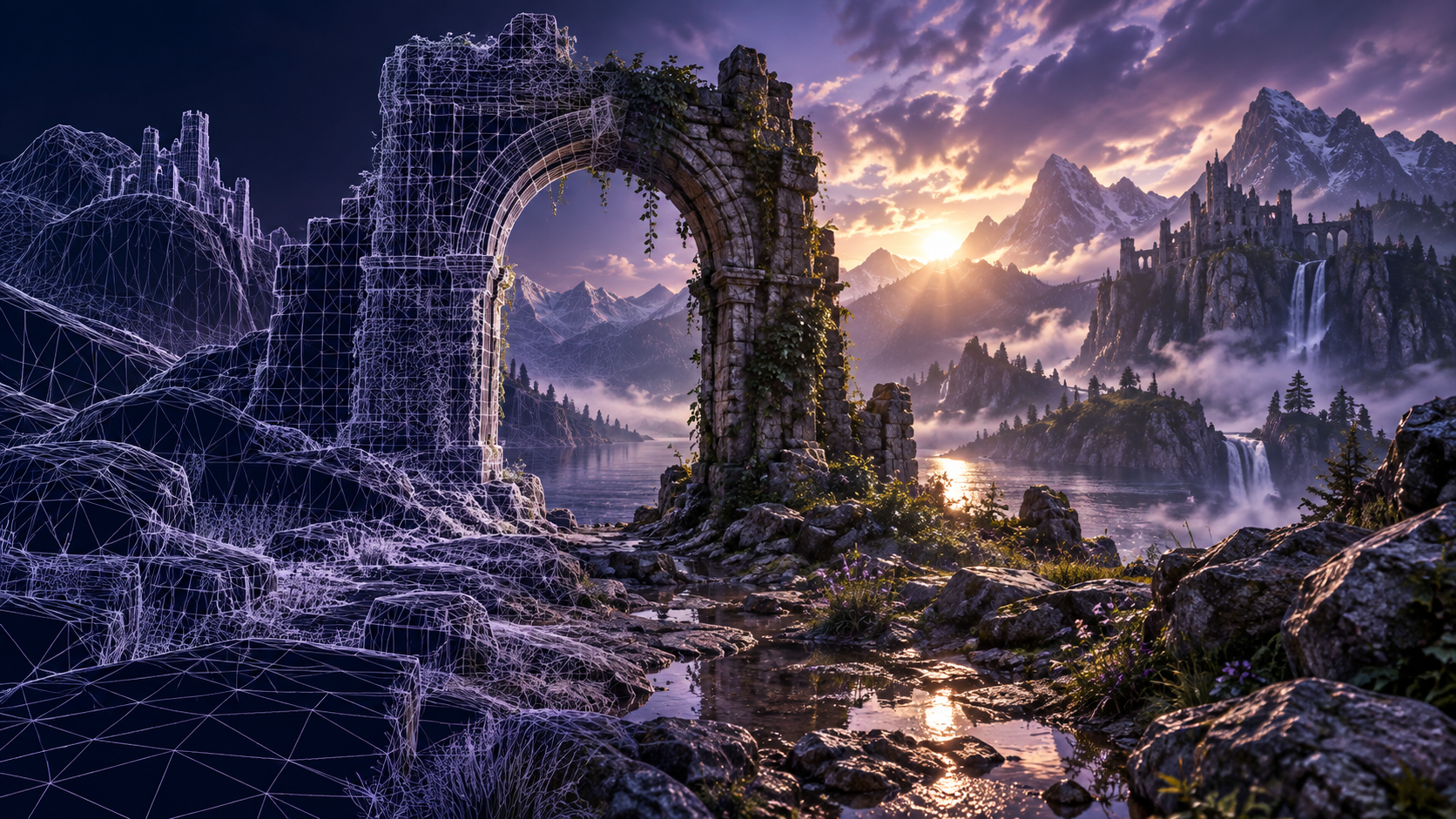
Real-time rendering has become the backbone of modern game visuals, powering everything from dynamic lighting and realistic characters to massive open worlds and cinematic storytelling. Unlike pre-rendered frames used in film, real-time rendering computes images instantly—often dozens or hundreds of times per second—so players can interact with worlds fluidly and without interruption.
As game engines evolve, real-time rendering is unlocking new levels of fidelity once thought impossible. Technologies like ray tracing, virtualized geometry, advanced shaders, AI-driven upscaling, and procedural rendering are transforming how games look, behave, and feel. Today, real-time rendering is not just about performance—it’s about immersion, artistry, and next-gen simulation.
This guide explores how real-time rendering has evolved, the technologies behind it, and how it continues to redefine next-generation visual experiences.
What Is Real-Time Rendering?
Real-time rendering refers to the process of generating images instantly as the player interacts with the game. Every motion, camera angle, lighting change, or animation triggers the engine to compute a new frame nearly instantly.
Real-time rendering must deliver:
High performance (60–120+ FPS for smooth gameplay)
Visual fidelity (detailed textures, natural lighting, realistic shaders)
Immediate responsiveness (no delays between player input and on-screen action)
Efficient resource use (optimized GPU, CPU, and memory performance)
Real-time rendering powers the visuals behind everything from FPS games and RPGs to VR simulations and cinematic cutscenes.
Why Real-Time Rendering Matters in Modern Games?
1. It Enables True Immersion
Players feel present when environments react instantly—lights flicker, shadows shift, and particles swirl in sync with movement.
2. It Supports Cinematic Storytelling
Cutscenes no longer rely on pre-rendered footage. Real-time cinematics can match the player’s character model, gear, and state dynamically.
3. It Powers Massive, Dynamic Worlds
Open-world games depend on real-time rendering to stream assets, generate landscapes, and react to player behavior.
4. It Enhances Gameplay Responsiveness
Combat, traversal, physics, and UI interactions require instant updates to feel smooth and intuitive.
5. It Future-Proofs Development
Studios can iterate faster, preview lighting instantly, and unify production workflows across departments.
Real-time rendering is the foundation of next-gen visuals.
The Evolution of Real-Time Rendering: From Polygons to Photorealism
Below is a balanced narrative breakdown of how rendering has evolved across generations.
1. The Early Polygon Era (1990s – early 2000s)
Early 3D games used simple polygonal models and flat shading. Low poly counts and limited textures defined the era.
Visual hallmarks:
Basic lighting
Simple geometry
Rigid animation
Blocky characters
Despite limitations, this era established the real-time foundations used today.
2. Shader Revolution & Normal Mapping (mid-2000s – early 2010s)
Programmable shaders changed everything, enabling artists to control lighting, surfaces, and materials more creatively.
Breakthroughs included:
Shader Model 3.0
Normal and parallax mapping
Reflection mapping
Dynamic shadows
Higher-resolution textures
This era also tied closely to improvements in modeling pipelines, such as those outlined in how artists use 3D modeling for games.
3. Physically Based Rendering (PBR) Becomes the Standard (2013 – 2017)
PBR created consistency by simulating how light interacts with surfaces in the real world.
PBR brought:
Accurate metalness and roughness
Unified material pipelines
Realistic reflections
Environment-based lighting
This allowed studios to achieve vastly higher realism.
4. Real-Time Volumetrics, GI, and Advanced Shaders (2017 – 2019)
Games began using more complex visual simulations.
Technologies included:
Screen-space global illumination
Real-time volumetric fog
Subsurface scattering for skin
Ambient occlusion advances
Improved particle rendering
These advancements also enhanced character visuals alongside animation systems explored in how video game animation brings characters to life.
5. Ray Tracing and Hybrid Rendering (2020 – Present)
The biggest leap in visual accuracy came from hardware-accelerated ray tracing.
Ray tracing enables:
Realistic reflections
Accurate global illumination
Natural shadowing
Physically correct light bounce
Because full ray tracing is still expensive, most engines use hybrid pipelines combining rasterization and ray tracing.
6. AI-Driven Rendering and Upscaling (Present → Future)
AI is now playing a major role in rendering pipelines.
Technologies include:
AI upscaling (DLSS, FSR, XeSS)
AI anti-aliasing
AI-based denoisers
Procedural AI-driven world generation
These trends align with future-forward insights in how AI in gaming is shaping the future of play.
AI rendering enables next-gen visuals without heavy performance demands.
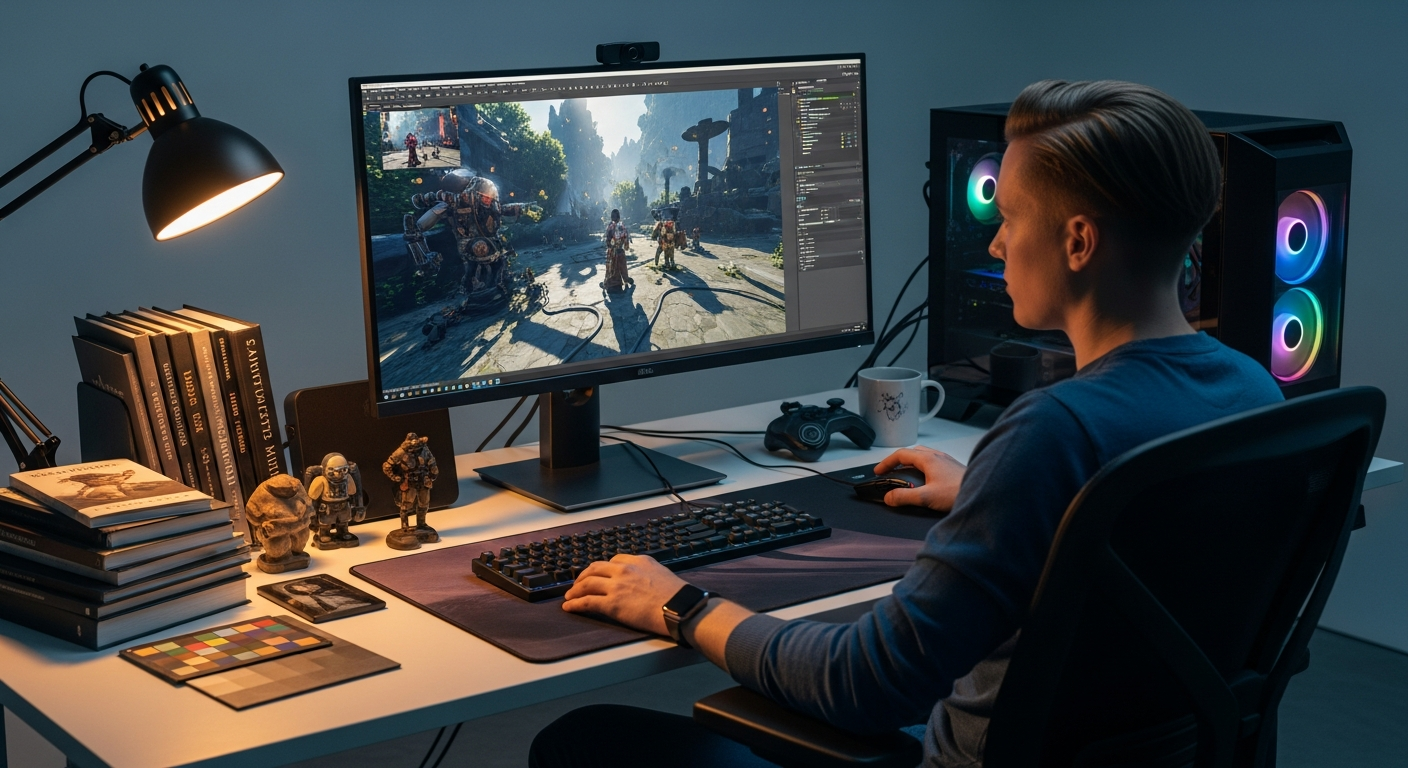
Key Technologies Behind Real-Time Rendering
Below is a balanced mix of the core technologies driving modern visual quality.
Physically Based Rendering (PBR)
Ensures materials behave consistently across lighting conditions.
Global Illumination (GI)
Simulates light bounce and ambient environmental lighting.
Ray Tracing & Path Tracing
Enables cinematic lighting accuracy in real time.
Virtualized Geometry (Nanite, etc.)
Renders billions of polygons efficiently using dynamic LODs.
Temporal Upscaling (DLSS/FSR)
Boosts resolution and frame rates using AI.
Volumetric Rendering
Simulates fog, clouds, smoke, and atmospheric scattering.
Complex Shader Networks
Control everything from skin to metals to water.
Particle and VFX Systems
Power explosions, spells, dust, sparks, smoke, and weather.
Real-Time Physics Simulation
Controls destruction, cloth, hair, and environmental interaction—an essential part of dynamic world-building described in why game environment design matters in modern games.
How Real-Time Rendering Impacts Game Development Pipelines?
1. Faster Iteration Cycles
Artists can preview lighting, materials, and animation instantly.
2. Unified Look Development
Art direction pipelines are more consistent across modeling, texturing, lighting, and animation.
3. Real-Time Cinematics
Cutscenes use the same assets as gameplay, reducing production cost.
4. Cross-Department Collaboration
Designers, artists, and animators work synchronously using real-time previews.
5. Multi-Platform Scalability
Rendering systems adjust for:
PC
Consoles
Mobile
XR / AR / VR
Real-time optimization increases reach and performance across devices.
Real-Time Rendering for Next-Gen XR and Virtual Experiences
Rendering plays a central role in VR and AR immersion.
XR requires:
High frame rates (90–120+ FPS)
Low latency
Detailed worlds
Dynamic shading
Efficient LOD systems
Real-time rendering drives comfort, clarity, and realism in immersive experiences.
Benefits of Real-Time Rendering for Next-Gen Visuals
Photorealism with high performance
Massive open worlds with seamless transitions
More expressive characters and animations
Dynamic lighting for cinematic experiences
Higher realism in physics and materials
Better accessibility across devices
Faster production pipelines
It makes games visually richer and development more efficient.
Challenges of Real-Time Rendering
Performance constraints
GPU hardware limitations
High development cost
Complex optimization
Large asset demands
Balancing fidelity vs performance
Ensuring consistency across platforms
Rendering is an art–science hybrid with many moving parts.
The Future of Real-Time Rendering
Real-time rendering is accelerating toward cinematic-quality visuals at gameplay frame rates.
Key future trends:
Fully real-time path tracing
Neural rendering (AI-driven realtime scenes)
Real-time global illumination without hacks
Procedural world generation from AI
Ultra-detailed landscapes using virtualized geometry
Holographic and XR-rendered worlds
Photoreal animation blending with real-time physics
Cloud rendering for lightweight devices
The future of real-time rendering is a blend of AI, simulation, and scalable graphics pipelines designed to deliver both beauty and performance.
Conclusion
Real-time rendering has evolved from basic shaded polygons into a powerful system capable of producing film-quality visuals at interactive frame rates. It drives every part of the modern game experience—from environments and characters to lighting, VFX, and cinematic storytelling. As technology advances through AI, ray tracing, virtualized geometry, and real-time simulation, rendering will continue pushing the boundaries of immersion and interactivity.
Mimic Gaming, with its expertise in character creation, real-time animation, environment development, and next-gen rendering pipelines, empowers studios to build visually stunning worlds that define the future of gameplay.
FAQs
1. What is real-time rendering in games?
It’s the process of generating visual frames instantly as players interact with the game.
2. Why is real-time rendering important?
It enables immersion, responsiveness, and cinematic visual quality during gameplay.
3. How does ray tracing affect real-time rendering?
It provides more realistic lighting and reflections by simulating light behavior.
4. What technologies improve real-time rendering?
PBR, virtualized geometry, temporal upscaling, AI denoising, and hybrid ray tracing.
5. Do all games use real-time rendering?
Yes—every 3D game relies on it, though fidelity levels vary.
6. Does AI improve real-time rendering?
Absolutely—AI accelerates upscaling, denoising, procedural generation, and optimization.
7. How does real-time rendering impact XR?
XR requires extremely fast, low-latency rendering for comfort and visual clarity.
8. What is the future of real-time rendering?
Neural rendering, full path tracing, and AI-driven simulation.
 June 5, 2026
 July 30, 2026
 November 18, 2025