
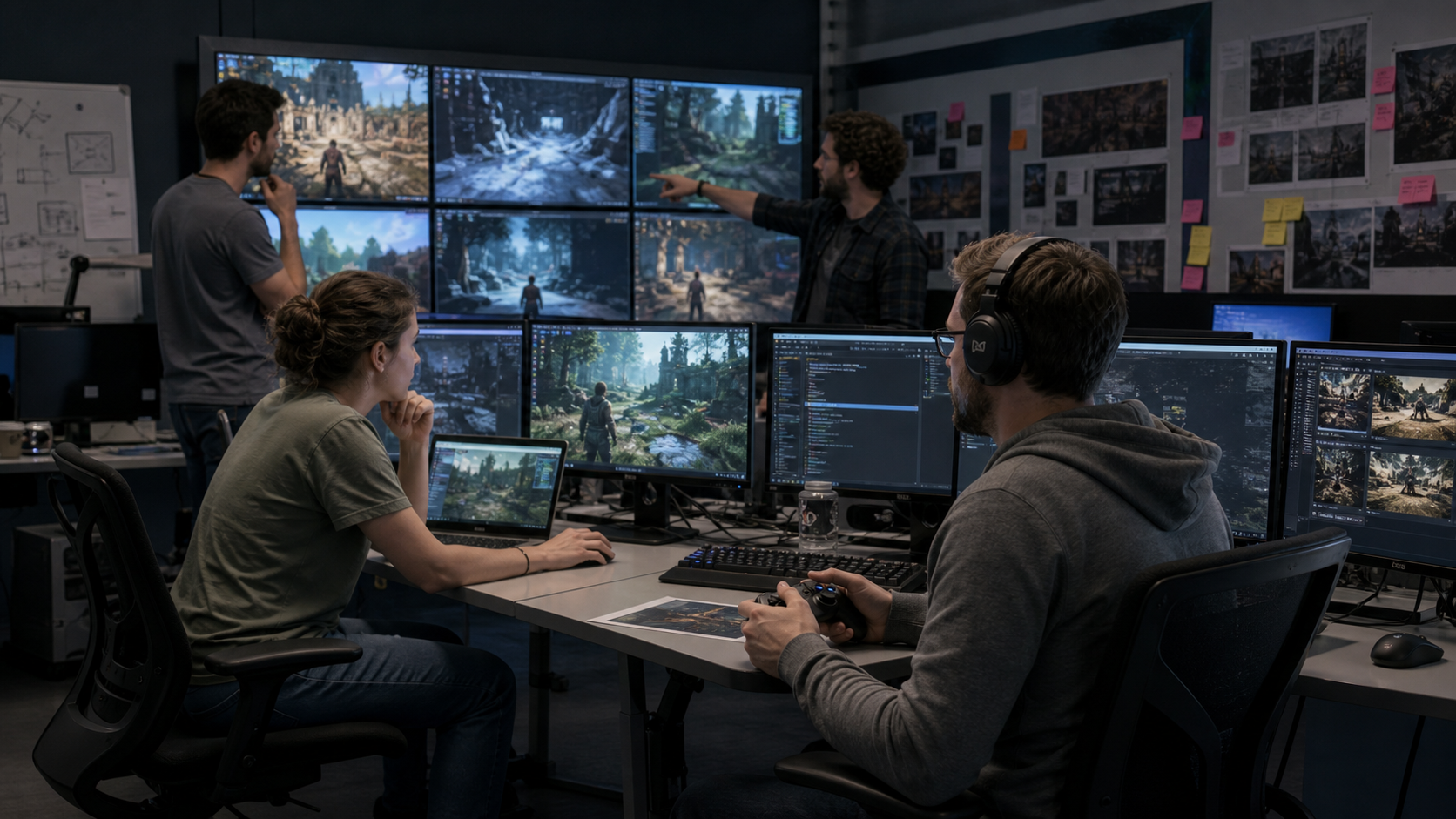

Adaptive game difficulty is becoming one of the most useful ways for studios to keep players engaged without flattening the experience. The idea is simple: the game observes how a player is doing and adjusts selected parts of the challenge so the session stays tense, readable, and rewarding.
For studios, the real work is not only adding an algorithm. Adaptive difficulty has to connect design intent, telemetry, AI behavior, simulation, animation, technical art, QA, and live-ops review. If the system is too obvious, players may feel manipulated. If it is too hidden, the team may not know why retention or frustration changed.
That makes adaptive challenge a natural extension of Mimic Gaming services, especially for teams building AI-assisted gameplay, engine-ready character systems, and production pipelines that need to work across Unity, Unreal, and proprietary engines.
What Adaptive Game Difficulty Means
Adaptive game difficulty, often called dynamic difficulty adjustment, is a design and technology approach that changes challenge based on player behavior. The system may adjust enemy aggression, spawn rates, resource drops, puzzle hints, checkpoint spacing, AI tactics, tutorial prompts, or encounter timing.
The best version is not a game secretly making everything easier. It is a controlled player-experience system. The design team decides which variables can change, how quickly they can change, and what should never be touched because it would damage fairness, mastery, or competitive integrity.
This is why adaptive difficulty belongs close to AI game testing and simulation. Studios need repeated playthroughs, behavior models, telemetry, and human review to understand whether the adjustment actually improves the experience or simply hides deeper design problems.
Why Studios Use Adaptive Challenge Systems
Studios use adaptive challenge systems because modern games serve many player types at once. A tutorial that feels smooth for a new player may bore an expert. A boss that delights a highly skilled player may block someone who loves exploration and story. A live-service event may need to challenge returning players without punishing new ones.
Better onboarding: early systems can identify confusion and offer help before the player quits.
Stronger retention: challenge can stay close to the player's current skill instead of drifting into boredom or frustration.
Cleaner live operations: telemetry can reveal where new content creates difficulty spikes after launch.
More useful QA: automated playthroughs can test many ability profiles before a build reaches players.
More believable AI: enemy behavior can adapt through tactics, timing, and team coordination instead of only health inflation.
Adaptive difficulty also helps production teams discuss challenge with evidence. Instead of arguing only from taste, designers, QA leads, producers, and engineers can review completion rates, retries, damage taken, hint usage, movement errors, encounter duration, and player sentiment together.
Static Difficulty vs Adaptive Difficulty
Static difficulty gives players a fixed rule set: easy, normal, hard, expert, or custom. Adaptive difficulty changes selected rules during play. Both approaches can work. The production question is where each approach protects the intended experience.
Static difficulty works well when players want control, mastery, speedrunning consistency, transparent challenge, or competitive comparison.
Adaptive difficulty works well when the studio wants smoother onboarding, better accessibility, smarter NPC behavior, or less punishing progression friction.
Hybrid systems often work best: players choose a baseline difficulty, while the game adjusts hints, pacing, or support tools inside approved boundaries.
Competitive modes need extra caution because hidden adjustment can damage trust, matchmaking clarity, and perceived fairness.
A good adaptive system should feel like better pacing, not like the rules are changing behind the player's back. The player should still believe success came from learning, timing, strategy, and expressive play.
Player Signals and Data Requirements
Adaptive difficulty depends on clean signals. A system cannot improve challenge if it reads the wrong data or ignores design context. Health loss, retries, completion time, aim accuracy, deaths, item use, movement pathing, inventory state, dialogue choices, tutorial behavior, and session length can all matter, but none of them tells the whole story alone.
Player performance data: retries, success rate, time to complete, damage taken, missed inputs, resource use, and objective progress.
Experience data: abandonment points, hint requests, repeated menu visits, camera struggle, accessibility settings, and tutorial restarts.
Game-state data: level, quest phase, inventory, enemy composition, difficulty baseline, platform profile, and current build version.
Content data: encounter type, animation state, AI behavior tree, environment layout, checkpoint placement, reward timing, and pacing goal.
Review data: designer notes, QA severity, user research feedback, support reports, and live-ops event outcomes.
This checklist ties directly into technical art pipeline planning. If assets, animation states, enemy behaviors, and engine hooks are not structured consistently, adaptive systems become difficult to test and tune.
Use Cases Across Game Genres
Adaptive difficulty should be genre-aware. A horror game, RPG, shooter, simulation game, sports title, and XR experience all create challenge differently. The system should adapt the right pressure points for the right player fantasy.
Action and shooter games: tune enemy tactics, spawn pressure, health pickups, aim assist, checkpoint spacing, and combat readability.
RPG and story games: adjust companion support, quest hints, resource generosity, encounter pacing, and optional challenge routes.
Simulation and strategy games: adapt AI planning, economy pressure, tutorial surfacing, scenario complexity, and recovery paths after poor decisions.
XR, VR, and AR games: adjust physical intensity, comfort settings, spatial cues, movement demands, and interaction timing to protect immersion and safety.
Mimic Gaming already has a useful content cluster around gaming genres and production pipelines, which makes this topic especially relevant. Different genres do not only change art direction. They change what the difficulty system is allowed to touch.
Implementation Plan for Production Teams
The safest production plan starts narrow. Pick one player journey, one high-risk friction point, and one measurable adjustment. A polished tutorial support system or boss retry model is more valuable than a broad adaptive layer nobody can explain.
Define the player promise, such as fair challenge, smoother onboarding, lower frustration, or stronger replay value.
Choose adjustable variables and protected variables. Protected variables are the rules the system should never change silently.
Connect telemetry, build versions, encounter IDs, player states, and QA notes so every adjustment can be reviewed later.
Simulate player profiles through automated playthroughs before real users encounter the system.
Launch with dashboards, rollback rules, and regular design reviews instead of treating the model as finished.
This is also where real-time gameplay animation matters. If a system changes enemy timing, companion support, or tutorial prompts, the animation and UI feedback must still communicate intent clearly.
Mistakes, KPIs, and Responsible AI
Adaptive difficulty can fail even when the technology works. Players are sensitive to fairness. If they notice that enemies suddenly miss, bosses lose intelligence, or rewards appear only after repeated failure, the system can feel patronizing rather than supportive.
Avoid changing core rules without communicating the design intent.
Avoid health sponges or invisible enemy nerfs when better pacing, tactics, or teaching would solve the problem.
Avoid overreacting to one bad attempt instead of looking for stable player patterns.
Avoid confusing accessibility support with difficulty reduction.
A studio should measure adaptive difficulty through player outcomes and production health, not only model accuracy. Useful KPIs include session length, tutorial completion, retry count, death distribution, time-to-success, support themes, QA reproduction speed, simulation coverage, and difficulty setting changes.
Adaptive difficulty often uses player behavior data, so privacy and trust should be designed early. Studios should define what is collected, why it is collected, how long it is stored, who can review it, and whether players can change settings or opt out of personalization.
For AI-driven companions or adaptive guide characters, the system overlaps with the AI NPC pipeline. Memory, moderation, telemetry, and gameplay state all need boundaries so the character remains useful, safe, and believable.
The future of adaptive game difficulty will combine telemetry, simulation, player-experience modeling, procedural content generation, accessibility settings, and AI behavior. Studios will use personalized tutorials, adaptive NPC allies, simulation-driven balancing, XR comfort systems, and human-in-the-loop dashboards where designers approve recommendations before release.
For studios using external production support, this will increase the value of partners who understand art, animation, engine integration, simulation, and QA together. Game art outsourcing will increasingly depend on whether assets and behaviors arrive ready for adaptive, data-aware production environments.
FAQ
What is adaptive game difficulty?
Adaptive game difficulty is a system that changes selected challenge variables based on player behavior, skill, progress, or context so the game stays engaging without becoming too easy or too frustrating.
Is adaptive difficulty the same as dynamic difficulty adjustment?
They are closely related. Dynamic difficulty adjustment usually describes real-time challenge changes, while adaptive difficulty can also include broader personalization, onboarding support, hints, pacing, and live-ops tuning.
Does adaptive difficulty make games unfair?
It can if handled poorly. Fair systems protect core rules, avoid obvious manipulation, and use adaptation to improve pacing, clarity, learning, or accessibility rather than secretly taking mastery away from the player.
What game data is useful for adaptive difficulty?
Useful data includes retries, deaths, damage taken, completion time, aim accuracy, resources used, hint requests, navigation errors, quest state, inventory state, platform profile, and player feedback.
Which genres benefit most from adaptive difficulty?
Action games, RPGs, simulation games, live-service games, sports games, racing games, and XR experiences can all benefit, but each genre needs different adjustment rules and trust boundaries.
Can AI help balance game difficulty?
Yes. AI and simulation can test many player profiles, identify difficulty spikes, support NPC behavior tuning, and help designers review challenge patterns. Human design judgment is still essential.
How should studios test adaptive challenge systems?
Studios should combine automated playthroughs, telemetry dashboards, QA review, user research, accessibility testing, and live-ops monitoring before expanding adaptive systems across the game.
What is the biggest mistake with adaptive difficulty?
The biggest mistake is hiding weak design behind invisible rule changes. Adaptive systems should support the intended experience, not cover poor encounter design, unclear feedback, or unfinished balancing.
Conclusion
Adaptive game difficulty is strongest when it respects the player. It should help a game teach, pace, challenge, and retain players while preserving the satisfaction of improvement. That requires more than an algorithm. It requires production discipline, clean data, believable animation, QA evidence, thoughtful design rules, and responsible AI boundaries.
For studios planning smarter challenge systems, AI-assisted gameplay, simulation testing, or engine-ready character behavior, talk to Mimic Gaming about production support for adaptive, player-aware games.
 June 15, 2026
 July 6, 2026
 November 21, 2025